


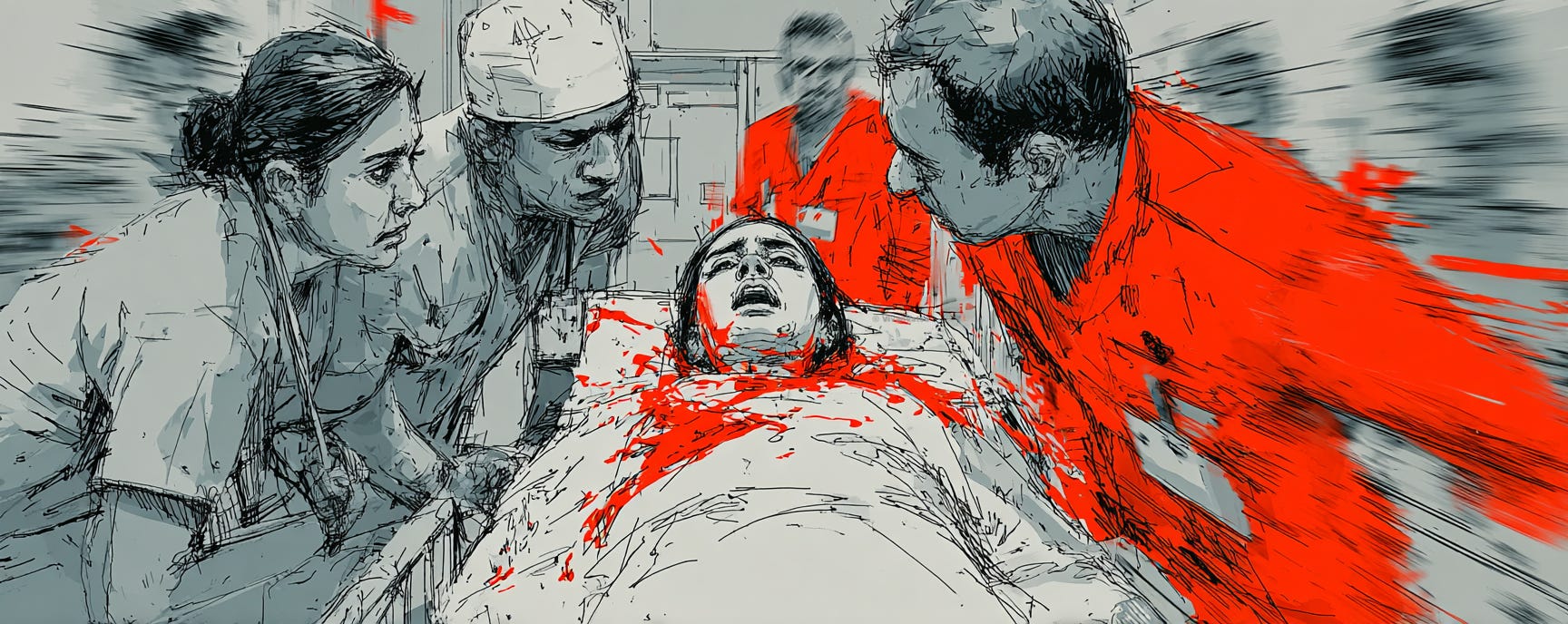
Degeneracy has many levels.
India scores the highest, in the most absurd state of affairs. It’s not that they try, but somehow it’s gotten in their survival spirit, damaging the reputation, India once had.
“Healing the world” - it was India’s mission at some point. Now it revolves around internal conflict, political conduit and timeless historical enunciations.
India has so much of false pride for the most bare minimum, we presume tasting the inevitable success is not in our kismat. It’s not written in our fate to shine like the extra ordinary.
Not just false pride, but cloaking ourselves with mediocrity, pretending to be confident, wetting ourselves if we get recognised in the international markets, without assessing at what cost.
The nation that looses their own sense of self, and only lives on rented decree of ‘living’ a lifestyle, can never grow beyond themselves.
India has no benchmark to measure or offer ultimate fulfilment. There’s always something missing. Something mending. Nothing getting completed. Just participating in this cyclic repository of nothingness.
It is well understood by now that Indians are unable to stare at their country directly for long. Might be the trauma or the distress that would drive them mad. Or maybe Indians are just emotional fools with no spatial awareness.
And also it is well swallowed hard pill that they have no sense of history.
For how then would they be able to squat amid their ruins, and which Indian would be able to read the history of their country for the last thousand years without anger and pain? It is better to retreat into fantasy and fatalism, to trust in the stars in which the fortunes of all are written - there are lecturers in astrology in some universities - and to regard the progress of the rest of the world with the tired tolerance of one who has been through it all before.
Expansive knowledge has always been concocted in India.
“Aeroplane was known to ancient India, so was the telephone, and the atom bomb: Evidences in the Indian history and Hindu epics are inevitable. Medicine and surgery was highly developed in ancient India; Indian shipbuilding was the wonder of the world. And democracy flourished in ancient India. Every village was a republic, self-sufficient, ordered, controlling its own affairs; the village council could hang an offending villager or chop off his hand. This is what must be recreated, this idyllic ancient India; and when panchayati raj, a type of village self-rule, introduced in 1962 there will be so much talk of the glories of ancient India, so much talk by enthusiastic politicians of hands anciently chopped-off, that in some villages of the Madhya Pradesh state, hands will be chopped off and people will be hanged by village councils.” - Excerpts from V.S Naipaul’s work.
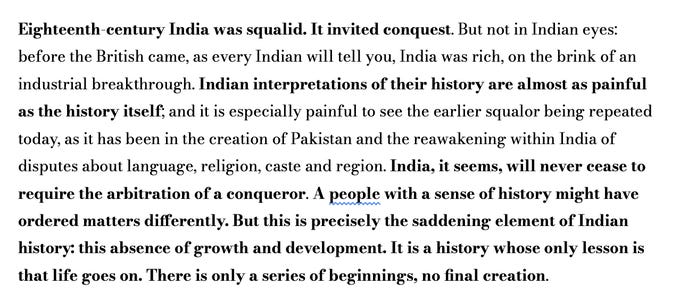
India is old, and India continues. But India owns nothing. All disciplines and skills that India now seeks to exercise are borrowed. Even the thoughts, perspective, opinions and ideas Indians have of their achievements or of their civilization are essentially the ideas given them by European scholars in the nineteenth century.
India loathes being diagnosed. And thus love prescriptions. Always. This is a well-oiled scheme, smooth enough to be lubricated by any foreign entity, standing by their shore to talk trade and never leave after that.
India lusts prescription over diagnosis so much that by itself it could not have rediscovered or assessed its past grift and glories. Its past was too much with it, was still being lived out in traditions, rituals, the laws, the divine; Complexity of India was never the dereliction of duty, but the burial of the pursuit of inquiry.
Now here is where something more sinister begins, something far more interesting and far more destructive than incompetence. India does not fail because it lacks talent. India does not fail because it lacks resources. India does not fail because it lacks intelligence. India fails because it has developed, over centuries of practice, an almost supernatural ability to prescribe solutions to problems it has never bothered to diagnose. Inculcating a civilizational habit so deeply ingrained that we cannot see it anymore, like fish cannot see water, like we cannot see the air that is slowly poisoning us because it has always been there and it will always be there and questioning its presence requires admitting it is poisoning us which requires admitting we are dying which requires admitting we were never healthy to begin with.
Think about this for a moment. Actually think about it. Not the way we usually think about India’s problems which is to immediately suggest what should be done about them but actually sit with the discomfort of asking why problems exist in the first place.
When was the last time you heard an Indian politician, an Indian intellectual, an Indian journalist, an Indian anyone, pause long enough to actually diagnose the disease before prescribing the cure? When was the last time anyone in this country said “wait, before we fix this, let us understand why this is happening” instead of immediately announcing scheme or policy or initiative designed to address symptom while leaving cause completely untouched? You cannot remember. Because it does not happen. It has never happened. We are nation of prescribers. Nation of solution-givers. Nation of people who see fire and immediately reach for extinguisher without asking why building caught fire in the first place.
India’s love for prescription over diagnosis is oldest disease in nation’s history and we have prescribed every possible cure for it except the only cure that would actually work which is diagnosis itself.
We see problem and we immediately reach for solution. We see poverty and we prescribe reservation. We see corruption and we prescribe transparency laws. We see pollution and we prescribe green energy targets. We see uneducated population and we prescribe mid-day meal scheme. We see farmer suicides and we prescribe loan waivers. Any of this is going to stabilise a nation like India? None of these are diagnoses. None of these are honest examination of why poverty persists, why corruption is structural, why pollution is profitable, why education remains inaccessible, why farmers are dying. These are all prescriptions administered to symptoms while disease continues metastasizing beneath surface undisturbed and untouched and unexamined because examining disease would require admitting that disease is not accidental but chosen, not unfortunate but functional, not something that happened to us but something we built and continue to maintain because maintaining it serves interests of those who have power to change it but choose not to.
You and I are not exempt from this. We do the same thing in our own lives. We see our unhappiness and prescribe new job, new city, new relationship, new hobby, new morning routine, new self-help book, new spiritual practice.
We never diagnose why we are unhappy. We never sit with discomfort of honest self-examination long enough to understand root cause. We immediately prescribe because prescribing feels productive. Prescribing feels like we are doing something. Diagnosis feels like we are stuck. Diagnosis feels uncomfortable. Diagnosis requires admitting we might be fundamentally confused about something we have believed our entire lives. And that admission is so terrifying that we would rather spend lifetime administering wrong prescriptions than spend one afternoon confronting correct diagnosis.
We are so much comfortable with chewing our problems with no taste, that prescriptions feels life-like and diagnosis feels like numbness.
India built this habit into its civilization and we perpetuate it without knowing we are perpetuating it. When British arrived they found civilization that had already stopped asking fundamental questions about itself and had replaced questioning with increasingly sophisticated systems for managing consequences of never having questioned.
But here is what makes India’s prescription addiction unique and particularly fascinating in its absurdity: we actually believe our prescriptions are working. That is the real disease. We genuinely believe prescription is same thing as cure.
We announce scheme and we measure whether scheme was implemented, not whether problem disappeared. We pass law and we measure whether law was passed, not whether law changed anything. We build road and we measure whether road was built, not whether anyone’s life became better because of road. Implementation is our metric. Impact is not. Case it as good governance. It’s not. This is performance of governance designed to look like action while achieving nothing except appearance of action.
Watch any Indian news channel for thirty minutes and you will see this disease in real time unfolding before your eyes with such brazenness that it is almost beautiful in its audacity. Minister announces scheme worth five thousand crores to solve rural poverty. Nobody asks how scheme will actually solve poverty. Nobody asks what diagnosis informed the scheme. Nobody asks why previous fifty-seven schemes addressing same problem produced no lasting result. Everyone just reports on scheme because scheme is news and news requires new prescription not boring old diagnosis. Scheme gets implemented partially because implementation is always partial in India. Scheme gets forgotten when next scheme is announced. Poverty continues. Next politician announces next scheme. Cycle repeats. Cycle has been repeating for seventy-seven years since independence. But nobody notices cycle because each individual prescription feels like progress even though cumulative effect of all prescriptions together is absolutely nothing except redistribution of blame across different governments and parties.
You are reading this and nodding.
You are agreeing.
You are thinking yes, India is broken, India needs to fix itself, India needs better solutions.
And you have just done the thing. You have just prescribed without diagnosing.
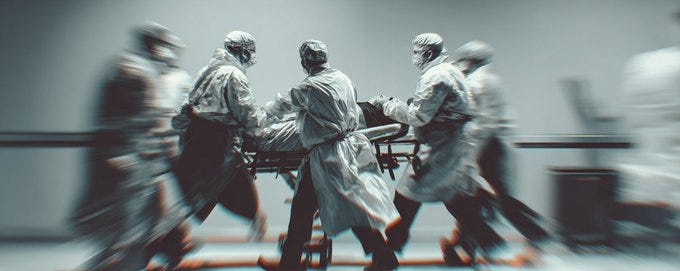
You have just looked at symptom and immediately reached for cure without asking why symptom exists. The question is not what India needs to do differently. The question is why India cannot ask what India needs to do differently. The question is not what prescription will work. The question is why we cannot stop prescribing long enough to actually examine what is wrong. And this question, this uncomfortable question that requires us to look at ourselves honestly for perhaps first time in our civilizational history, is question we will not ask. Because asking it requires admitting that we are addicted to prescribing. That we are comfortable with prescribing. That prescribing makes us feel useful and important and busy without actually requiring us to change anything fundamental about who we are or how we operate.
Bhagavad Gita, which we quote constantly as source of wisdom, actually contains diagnosis Krishna gives Arjuna that nobody in India bothers to actually apply to national life. Shri Krishna does not prescribe solution to Arjuna’s paralysis. Krishna diagnoses root cause of paralysis which is Arjuna’s attachment to outcomes, his confusion about dharma, his inability to act without certainty of results. Krishna spends eighteen chapters diagnosing before offering any prescription and even then prescription is not external action but internal transformation.
Compare this to how we govern India where prescription is given within seconds of problem being identified and internal transformation of society or individual is never even considered as possible solution because internal transformation cannot be announced on television and cannot receive votes in election.
There is something deeply revealing about nation that claims to be birthplace of philosophy, claims to be originator of world’s deepest spiritual traditions, claims to have produced greatest thinkers in human history, and yet cannot perform most basic intellectual exercise that every philosopher worth their salt performed which is examining assumptions before acting on them.
We skipped examination entirely. We went straight from ancient wisdom to modern confusion without passing through middle step of actually understanding what ancient wisdom was saying. We treat Vedas and Upanishads and Gita like prescription manuals, like cookbooks with recipes for success, rather than diagnostic texts that were specifically designed to help human beings understand why they are suffering before attempting to address suffering. Every great scripture of Sanatan tradition begins with diagnosis. Arjuna must be shown truth about nature of reality before he can act. Nachiketa must understand death before he can transcend it. Shiva must explain to Parvati why attachment creates suffering before dissolution of attachment becomes possible. Diagnosis first. Always diagnosis first. We reversed this order and built civilization on prescription without diagnosis and we wonder why nothing works.
But the most delicious irony, and this is where it gets truly absurd in way that would make gods laugh if gods existed which they might but they have probably given up on India by now, is that India’s prescription addiction is itself symptom of deeper disease that nobody is diagnosing: The deeper disease is that we were taught, somewhere deep in our collective unconscious, that problems are meant to be solved rather than understood. That action is virtue and contemplation is laziness. That doing something is always better than understanding something. This is not Indian philosophy. This is industrial age thinking that colonized Indian mind more thoroughly than British ever colonized Indian body. British took land and resources. Industrial thinking took our capacity to sit with questions. And we welcomed industrial thinking because it felt productive. It felt like progress. Sitting with questions felt like wasting time. Understanding felt like luxury we could not afford.
So we chose action over understanding every single time and we built civilization that is perpetually busy, perpetually implementing, perpetually prescribing, and perpetually failing to address anything at its root because addressing things at root requires exactly the kind of patient, uncomfortable, unproductive examination we decided centuries ago we did not have time for.
You want to understand India?
Do not look at our schemes or our policies or our five year plans or our GDP growth or our infrastructure projects. Look at our inability to pause. Look at how we cannot tolerate silence. Look at how every Indian you know is constantly doing something, planning something, fixing something, achieving something, and how none of that doing and planning and fixing and achieving has produced anything resembling collective wisdom or shared understanding of why we are the way we are. We are nation in perpetual motion toward destinations we never chose because we never stopped long enough to choose them.
We are running from something we never identified because we were always too busy running to identify it. And the something we are running from is simply the question of who we are and why we exist and what this civilization is actually for. That question, that singular devastating question that every great civilization must eventually confront, is the diagnosis India has never performed. And until we perform it, until we actually sit with that discomfort and examine ourselves with same brutal honesty that we apply to everyone else, every prescription we administer, every scheme we announce, every solution we implement, will continue doing exactly what all prescriptions do when administered to patient who was never examined.
They will make us feel like we are getting better while disease continues to eat us alive from inside, quietly, patiently, with absolute certainty that it will outlast every prescription we ever give it, because disease understands something prescription never can, which is that you cannot cure what you refuse to see.
To my future India, never forget: the one controlling the narrative always think the world is ugly and his/her ideas are going to take you out of misery. That’s where the downfall society begins when you decentralise thinking and concentrate power.
JAI HIND.